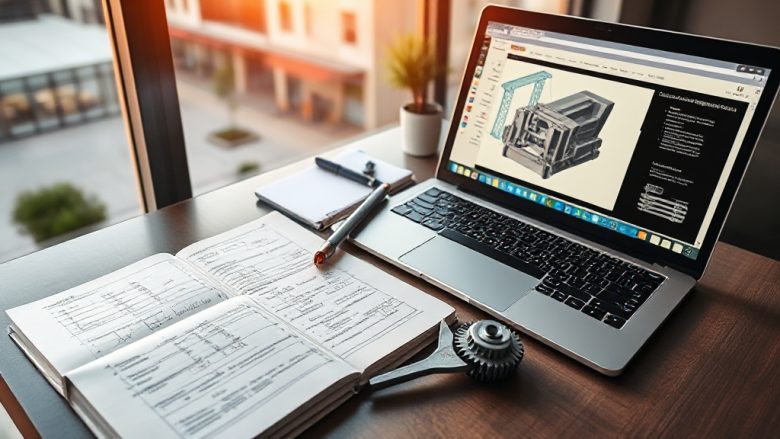
The best resources for learning mechanical engineering depend on what you actually need: credentials, practical skills, or a portfolio that proves you can build things. Most people chase one category and neglect the others, then wonder why they can solve exam problems but freeze in front of a real machine. This comparison maps the main options — degrees, online courses, textbooks, simulation software, and hands-on projects — and shows how to sequence them so nothing gets wasted.
Formal Degrees: The Credential Path
A university degree remains the default route for anyone who wants to work as a practising engineer, sit professional exams, or move into regulated industries like aerospace and pressure systems. The structure is the selling point. You get thermodynamics, fluid mechanics, solid mechanics, materials, dynamics, and control theory in a deliberate order, each course building on the last. Labs force you to measure things and discover that real data is messy. Group projects teach you that half of engineering is coordination.
The drawbacks are obvious. It takes three to five years, costs a great deal in most countries, and moves slowly. A module on manufacturing processes might spend six weeks on content you could absorb from a good textbook in a fortnight. If you already have a degree in a related field, a master’s conversion course can be a faster route than starting over.
Choose a degree when credentials are non-negotiable. Skip it when you want skills for a specific job, a hobby, or a startup where nobody asks for your transcript.
Free and Low-Cost Online Courses
Open courseware and MOOC platforms have quietly become serious. Lecture series from major technical universities cover statics, dynamics, thermodynamics, and machine design at full degree depth, complete with problem sets. The catch is that nobody marks your work, so you have to be honest with yourself about whether you actually solved the problems or just watched the videos.
Short courses work better for filling gaps than for building foundations. If you already understand beam bending but keep getting confused by fatigue life estimation, a focused four-week course is efficient. If you don’t understand free body diagrams, a short course will paper over the problem and it will resurface later.
Use online courses for three things: previewing a topic before a formal module, revising one after it, and patching specific weaknesses. They are poor substitutes for the full sequence, and excellent supplements to it.
Textbooks: Still the Backbone
Engineering is one of the few subjects where the textbook has not been displaced. A good mechanics of materials text, worked through properly, beats a dozen video playlists. The reason is density. A chapter can present a derivation, three worked examples, and forty problems in the space a video spends on one concept.
The practical approach is to pick one core text per subject and actually finish it. For statics and dynamics, a standard undergraduate text with plenty of problems. For thermodynamics, something with clear property tables and cycle analysis. For machine elements, a design-focused reference you will keep on your desk for years. Buy older editions. The physics has not changed, and the price difference is enormous.
Work problems with a pen. Reading a solution and nodding is not learning. Close the book after the example, redo it from scratch, then check. This single habit separates people who understand the material from people who recognise it.
Simulation Software and CAD Tools
Modern mechanical engineering runs on software, and employers expect familiarity with at least one CAD package and one analysis tool. The good news is that capable free options exist for students and hobbyists, and the underlying concepts transfer between packages.
Learn CAD by modelling real objects, not tutorials. Pick something on your desk, measure it with calipers, and rebuild it as a parametric model. Then change a dimension and check that the model updates cleanly. That skill — building models that don’t explode when edited — is what separates a useful CAD user from someone who can only follow instructions.
For simulation, start with hand calculations before touching the software. Calculate the deflection of a cantilever beam analytically, then model it and compare. If the numbers disagree wildly, you have a meshing, boundary condition, or units problem, and you will only spot it because you did the maths first. People who skip this step produce colourful pictures that mean nothing.
Hands-On Projects and Workshops
Nothing teaches mechanical engineering faster than building something that has to work. A project forces you to confront tolerances, friction, vibration, thermal expansion, and the gap between a clean drawing and a part that actually fits. It also builds the portfolio that matters more than grades in many hiring conversations.
Start small and finish. A bicycle repair, a gear train from a kit, a small heat exchanger, a robot arm with real bearings — the topic matters less than completing the loop from design to test. Measure something, predict it, then measure again. Keep notes. A logbook of what failed and why is worth more in an interview than a list of modules passed.
If you lack tools, look for makerspaces, university workshops open to the public, or community repair cafés. Access to a lathe, a mill, and someone who knows how to use them safely is a resource in itself.
How to Combine Them: A 12-Week Plan
Here is a sequence that works for a self-directed learner who already has some mathematical background. It assumes roughly ten hours a week.
Weeks one to three: pick one core textbook on statics and work through the first third, solving every problem. In parallel, start a CAD model of a simple assembly and rebuild it from scratch twice. Weeks four to six: move to mechanics of materials. Calculate stress and deflection by hand for three simple structures, then verify each with a simulation tool. Note every discrepancy. Weeks seven to nine: choose a small physical project and design it properly — drawings, material selection, a bill of materials. Order parts. Weeks ten to twelve: build it, test it, and write up what you got wrong. That write-up is your first portfolio piece.
Throughout, use online lectures to preview topics the day before you read them. Previewing makes textbooks far easier to absorb. And keep a single notebook for derivations you had to fight for — you will revisit them.
If you need a credential, slot formal study around this skeleton rather than replacing it. The projects and textbook work make the degree easier, not harder.
FAQ
Can I learn mechanical engineering without a degree?
Yes, for many practical roles and for personal projects. You can build strong skills through textbooks, online courses, simulation tools, and hands-on work. What you cannot easily do without a degree is enter regulated fields or sit professional engineering exams in most jurisdictions. Be clear about which of those you need.
Which should I learn first, CAD or theory?
Learn the theory first, at least the basics of statics and materials. CAD is a tool for expressing design intent, and you cannot express intent you don’t understand. That said, start using CAD early in parallel — it makes the theory concrete and keeps motivation up.
Are free online courses enough on their own?
Rarely. They are excellent for previewing, revising, and patching gaps, but they lack the problem sets, feedback, and sequence of a full programme. Pair them with a textbook and a real project, and they become genuinely powerful.
How much maths do I need?
Calculus, linear algebra, and differential equations cover most of the core. You do not need to master them before starting mechanics. Learn the maths alongside the engineering, applying it immediately, and it will stick far better than studying it in isolation.